
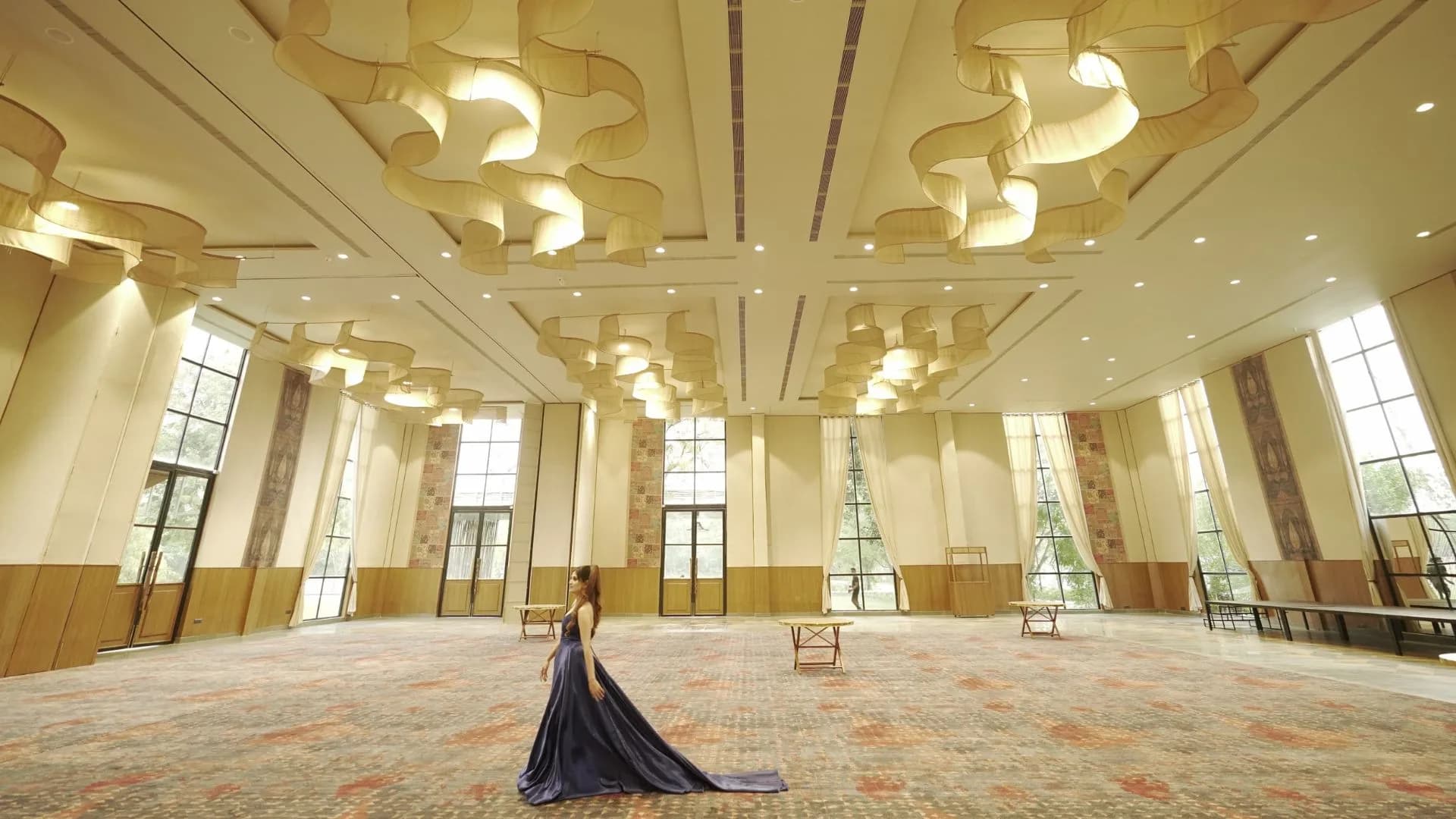
There is a particular pause that happens when a wedding planner walks into the Aria Grand for the first time. They look up — at a 25-foot ceiling — and then they walk a slow, deliberate circle of the floor. Three-quarters of the way around, they stop. And they nod.
What they're looking for is the columns. There aren't any.
The constraint a column creates
A column inside a banquet hall is not just an architectural fact. It is a planning problem.
It dictates where you can put the mandap. It blocks sightlines from the back of the seated area. It interrupts the photographer's wide. It makes table layouts a compromise between "where would we put it ideally" and "where can we put it given the structure." In rooms with multiple columns, planners spend the first hour of a site visit just walking the floor with masking tape, marking what's actually usable.
In a 9,500 square foot space, even one column in the wrong spot can lose you fifteen percent of practical capacity.
What pillarless costs
A lot, structurally. The roof spans the full width of the hall in a single, engineered truss — the kind of beam-and-cable system you usually see in airport terminals or amphitheatres. The slab depth on a pillarless hall is significantly thicker than a column-supported one. The materials cost more. The build takes longer.
The cost is borne once, by the resort. The benefit is borne every weekend, by every family who hosts a wedding here.
A pillarless hall does not look more special. It works more special. The difference shows up in the photographs.
What it lets us do
A few specific things, in order of how often planners ask about them:
- Mandap placement. You can position the mandap anywhere — centred, off-axis, against the long wall — without an engineering compromise. We have hosted weddings with the mandap directly under the central spotlight, fifty feet from the nearest support.
- Capacity that matches the floor plan. With its vast attached lawn, the Aria Grand scales to gatherings of up to 2,000 guests. That number is not theoretical. It is what the layout actually permits.
- Drapery and lighting. A pillarless hall lets a lighting designer rig from the ceiling without compromises. Sweeping fabric, suspended floral, projection mapping — all of these work cleanly when there isn't a column in the way of the rigging point you wanted.
- Photography. The wide shots become genuinely wide. Drone footage from the lawn into the hall doesn't catch a pillar mid-frame. It is the kind of detail you don't notice until you've seen the photographs of a wedding that didn't have it.
When pillarless doesn't matter
To be fair: for a 200-person sangeet on a soft lawn evening, none of this matters. You'd be at Cocktail Lawn or Sudesh II, and a column would never have been in your way.
Pillarless matters when scale meets intent. A 1,500-guest reception with a mandap, a stage, multiple food counters, a working bar, photographers and videographers all needing space to move — that is when the absence of one inconvenient column becomes the reason your weekend went smoothly.
And the smaller siblings
Across from the Aria Grand sit the Aria sub-spaces — Aria I + II + Deck (3,500 sq ft) and Aria III (6,000 sq ft) — also pillarless, designed for mid-sized functions where you want the same column-free freedom at a smaller footprint. A board meeting can comfortably take Aria III; a 400-guest reception can take Aria I + II + Deck; the headline ceremony fills the full Grand. All three connect, so the same wedding can use all three across a weekend.
It is not a small architectural choice. It is the difference between a hall that can be decorated and a hall that gets out of the way of what you want to celebrate.
Planning at this scale? Start with the destination wedding guide and the 12-month planning timeline, or walk the hall with us.